Showing posts with label aircrafts. Show all posts

Monday, July 5, 2010

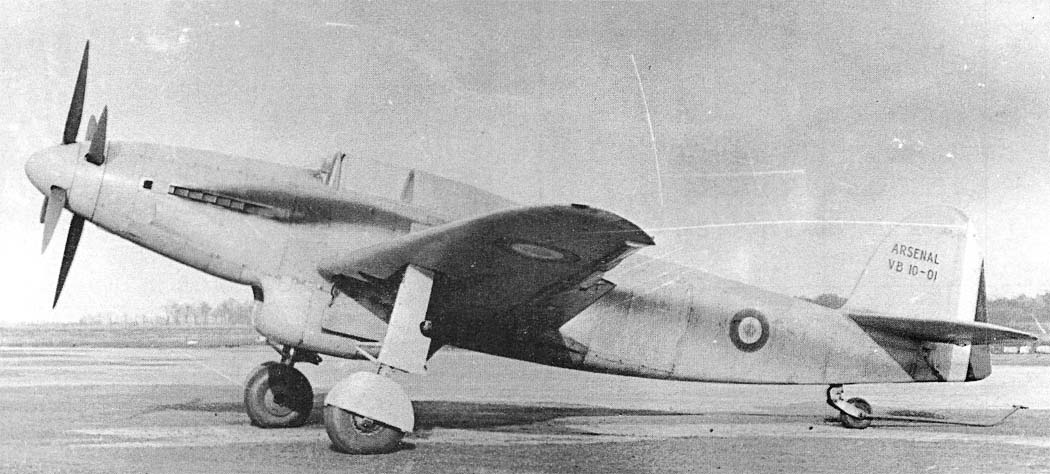
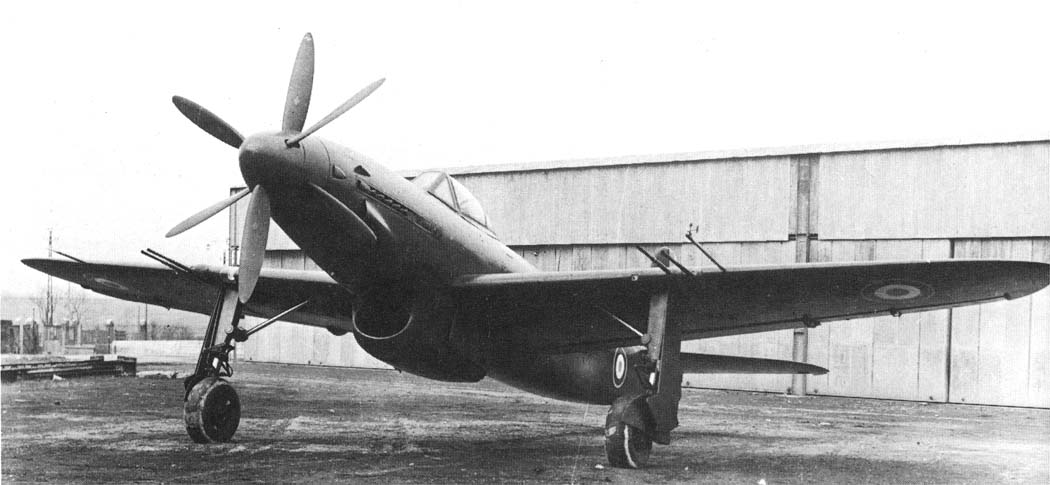
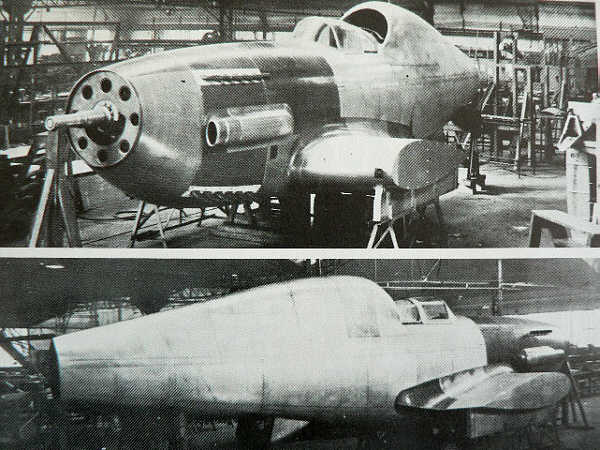
Arsenal VB-10

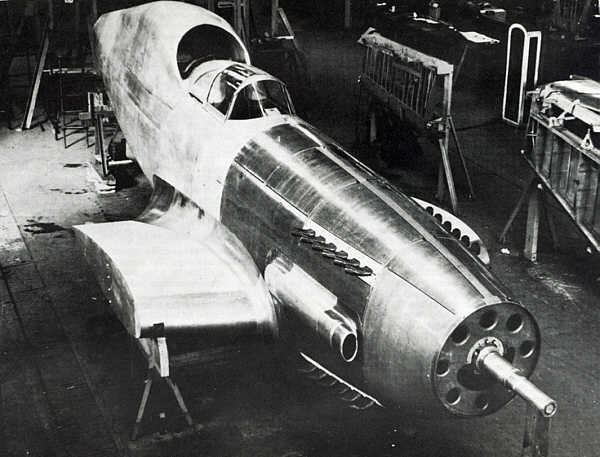
The Arsenal VB-10 was a French Tandem engines  fighter prototypes developed during and shortly after World War II. It was a monoplane with largely orthodox configuration and retractable tailwheel  the VB 10 added a second engine behind the cockpit which drove a second propeller, coaxial with and counter-rotating to the propeller driven by the engine in the nose. Although the aircraft was first designed (and indeed ordered) in 1940, but because of French occupation, the aircrafts could not flown until  Europe was freed .But then, the Amee de air changed their favor on the jet technology and age of piston engine was over so the project was cancelled  in 1948 and all 6 prototypes were scrapped.
Specification
General characteristics
  • Crew: one, pilot
  • Length: 12.98 m (42 ft 7 in)
  • Wingspan: 15.49 m (50 ft 10 in)
  • Height: 5.2 m (17 ft 1 in)
  • Wing area: 35.5 m² (382 ft²)
  • Powerplant: 2 × Hispano-Suiza 12Zars-15/16, 860 kW (1,150 hp) each
Performance
  • Maximum speed: 700 km/h (435 mph)
  • Range: 7,700 km (1,056 miles)
  • Service ceiling: 11,010 m (36,120 ft)
  • Rate of climb: 10.2 m/s (2,008 ft/min)
Armament
References 

Monday, June 21, 2010

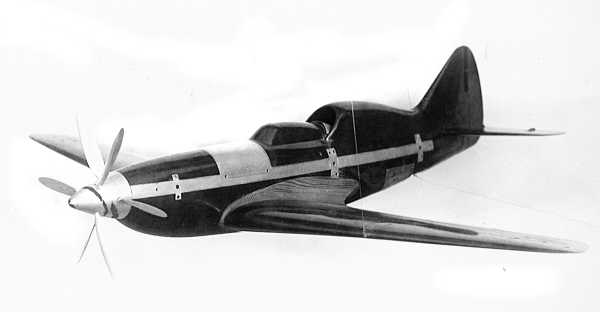
Dewoitine /Sud Est SE 580

In 1944, when France been freed , the Aeronautic Manufacturing National Societies or SNCA try to built a new type of fighter based on the project of the SNCA du Midi M 580-an early design of SE 580 in 1940, the SE 580 wing planform-with its near mid-chord single spar and its empennage surfaces planforms-was similar to the D520, albeit the horizontal planes had slightly greater aspect ratio. Initially designed to be powered by the 24-cylinder Hispano Suiza 24Z (H type) of 2,000hp, its postwar redesign accommodated the 24-cylinder arsenal 24 H of 3,400hp. This latter engine used the cylinder blocks of the German Junkers IV12 213 engine.

Two 12.1-foot-diameter coaxial, counter-rotating propellers were to be utilized for propulsion.
It was to be armed with a 30mm cannon firing through the propeller axis, plus four 20mm cannon and either eight 7.Smm or six 12.7mm machine guns mounted in the wings outboard of the propeller arc. A 500kg (1,100 lb.) bomb could be carried beneath the fuselage. It is obvious that the after-cockpit buried radiator with top-mounted radiator intake was for protection from ground fire.

One thing was sure is 2 prototypes were ordered but they were not complete because the project was cancelled when the Amee de Air( French airforce) focus more on jet fighters along with it competitor-the Arsenal VB-10 shortly thereafter.
Specification
  • Powerplants:Hispano Suiza 24Z(2x Hispano Suiza 12Z)
  • Armaments:30mm cannon in the props axis, 2x HS 404 cannons in each wing
  • Propellers:6 blades contra rotating props or 5 blades counter rotating prop
  • Span 15.862m
  • Length 13.000m
  • Weight 5093kg 
  • Maximum speed 749km/h

Monday, May 24, 2010

Antonov Istrebitel

In 1944, Antonov was impressed by Heinkel He 162 jet fighter from Germany. So he tried to made his own design of a superior fighter with a single RD-10 turbojet.  The  armarments was to be 2x NK-23 cannons in nose. The cockpit seemed to be like P-39 Aircobra because it have an openable door.  Later, Soviet requires of a jet fighter, so the project were given the number An-2 or SKh.  But later,  the new jet fighter with better configuration,the Yakolev Yak 10 was flown and tested with the same engine and weapons but more performance so the project of Antonov were no more than the wind tunnel model and cancelled.
                                                                     Istrebitel windtunnel model
Performance
  • Powerplant: 1x RD-10 axial flown turbojet
  • Armarment: 2x NK-23 30mm cannon
  • Span:10,8m
  • Length:10,6m
  • Max Speed: about 900km/h                
  • Crew:1 pilot

Douglas XB-31


The Douglas XB-31 was a was the design submitted by Douglas aviation company to US army air corp as a requirement of a long range heavy bombers. Around 1938, United States Army General Henry H. 'Hap' Arnold, the head of the Army Air Force, was growing alarmed at the possibility of war in Europe and in the Pacific. Hoping to be prepared for the long-term requirements of the Air Force ,Arnold created a special committee chaired by Brigadier General W. G. Kilner;,one of its members was Charles Lindbergh. After a tour of Luftwaffe bases, Lindbergh became convinced that Nazi Germany was far ahead of other European nations.  Despite the promising design, it never progressed past the design stage, the reason is because the Boeing B-29 was already chosen to be main  heavy bomber for Pacific theatre.
Specifications
  • Crew: 8 (2 pilots, 4 gunners, 1 radioman, 1 radar technician)
  • Length: 35,7m
  • Wingspan:63.1 m
  • Height:12,99m
  • Wing area:310m²
  • Empty weight:49,530 kg
  • Loaded weight:60,870 kg
  • Take off weight:89,800 kg
  • Powerplant: 4x Pratt & Whittney Wasp Mayor radials
  • Max speed:357mph
  • Range:3000 miles
References: http://en.wikipedia.org/wiki/Douglas_XB-31

Myasischev M-50 Bounder

In 1955,the Myasischev OKB(bureau) has headed toward on a research to built a supersonic bomber. The archives of the design were the dash attacks,fast bombing, nuclear bomber.The project was begun in 1955 and 2 protypes were ordered from Soviet airforce.Many designs were made until they have a new designs
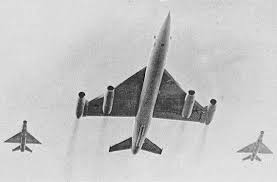
. The design name's M-50 for first prototype. 2 prototypes were built but only one of them, the M-50 were flown because the project was cancelled later. Even the project was cancelled, the M-50 still have a decision to made it final flight in Tushino show.  Another prototype for M-50 project, the M-52 also built as a nuclear bomber but after the project cancelled the aircraft complete but  it was never have flight test and scrapped . There are also many other projects about the M-52  with other configuration but they were never built.Later it was received  considerable attention from westerns observers and was given the NATO name's Bounder and presented at Tunisho show for now.
Description
Designer : OKB V.M.Myasishchev
NATO code name; Bounder
Role:Strategical supersonic bomber
Crew:2 pilots
Specification
1.M-50A
General characteristics
  • Crew: Two
  • Length: 57.48 m (188 ft 6 in)
  • Wingspan: 35.10 m (115 ft 2 in)
  • Height: 8.25 m (27 ft 1 in)
  • Wing area: 290.6 m² (3,128 ft²)
  • Empty weight: 85,000 kg (187,000 lb)
  • Loaded weight: 175,000 kg (386,000 lb)
  • Max takeoff weight: 200,000 kg (440,000 lb)
  • Powerplant: 2× Dobrynin VD-7M afterburning turbojets, 156.9 kN (35,270 lbf) each, and 2× VD-7B turbojets, 92.12 kN (20,710 lbf) each
Performance
Armament
  • 30,000 kg (66,000 lb) of bombs or missiles carried in internal bay
References:http://en.wikipedia.org/wiki/Myasishchev_M-50
2.M-52A
  • Length:57,48m  
  • Overall height:8,25m
  • Wing Span: 25,1m
  • Wing Area:290,63 m2
  • Take-off weight: 115000kg
  • Weight:78860 kg
  • Engines:2 VD-7B + 2 VD-7 turbojet engines
  • Speed:1050 km/h
  •  Practical range: 3150km
  • Practical ceiling: 11000m
  • Landing run:1800m 
references: http://www.testpilot.ru/russia/myasishchev/m/52/m52.htm


                                                                    Pictures


                                                                         M-50 drawings
                                             
                                                                     M-50 for today
                                                      M-52 wind tunnel models
                                                     
                                            M-52 prototype awaiting for test flight
                                            M-50 in flight