Monday, June 7, 2010

Roll Royce Medway

Roll Royce Medway  is a proposed large low-bypass turbofan engine produced by Roll Royce and tested in early 1960s.  The project was cancelled due to favor of the Roll Royce Spey engine and the cancellation of Armstrong Whitworth AW.681 VTOL transporter project.
The development of this engine were based on the Roll Royce Pegasus engine which were used for Harrier prototype, it was designed byby a team led by Alan Arnold Griffith, the RB.141 was originally designed to meet a new propulsion requirement for the de HavillandDH.121 airliner project which later became the Hawker Siddeley Trident. The engine was later named after the River Medway in line with Rolls-Royce company tradition for jet engines.
The first application for the medway is the Armstrong Whitworth AW 681 VTOL transporter prototype.
The rear section of the engine was modified to incorporate an internal thrust deflector to duct exhaust gases through swivelling nozzles; an idea similar to that used on the contemporaryBristol Siddeley Pegasus. Cancellation of the AW.681 project however also brought to an end further development work on the Medway with attention turning to the smaller, but very closely related, Spey turbofan.
Another application is for the SAAB Vigen, the Sweden military attack aircraft but due to government funding, the idea was not adopted.
In December 1963 the Medway had successfully completed over 1,700 hours of bench running.


Specifications (RB.141-3 Medway)


General characteristics

  • Type: Low bypass twin-spool turbofan
  • Length:
  • Diameter:
  • Dry weight:

Components

  • Compressor: Axial, 5-stage LP, 11-stage HP
  • Combustors: Cannular, 10 chambers
  • Turbine: 2-stage LP, 2-stage HP

Performance

References:http://en.wikipedia.org/wiki/Rolls-Royce_Medway


Curtiss XP-71

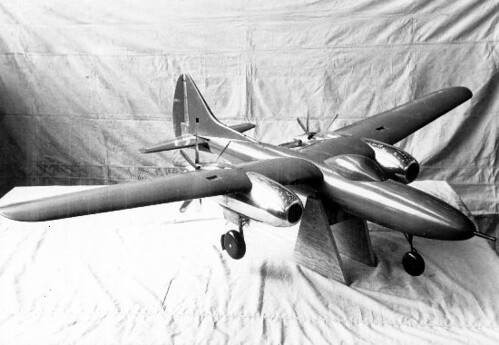
Curtiss XP-71 was a 1940 proposal of a heavy escort fighter aircraft for USAAF.  It was equipped with a pressurized cockpit and equipped with two Pratt and Whittney Wasp Mayor radial engines.  It featuring the pusher configuration with 8 countra rotating propellers. Based on the experience of heavy fighter, these type of aircrafts were requested as escort for bombers.  Two prototypes were ordered.  The development were equipped with Wasp Mayor turbocharged radial engines was supposed to be the biggest aircraft during the war
The final design of the XP-71 was bigger than the B-25 Mitchell medium bomber so this complex aircraft was considered to be need a lot of resources to built.  A mock up was built to gained data for the prototypes but later, the requirement of more advanced fighters such as jets led to the cancellation of the XP-71 project and the prototype was never built in 1942.
Specification
General characteristics
Performance
  • Maximum speed: 428 mph (371 knots, 690 km/h) at 25,000 ft (7,620 m)
  • Range: 3,000 mi (2,600 nm, 4,800 km)
  • Service ceiling: 40,000 ft (12,192 m)
  • Max wing loading: 51.6 lb/ft² (252 kg/m²)
  • Minimum power/mass: 0.147 hp/lb (242 W/kg)
  • Time to altitude: 12.5 min to 25,000 ft (7,620 m)
Armament
  • Guns:


    • 2× 37 mm (1.46 in) cannon
References: http://www.secretprojects.co.uk/forum/index.php/topic,3281.0.html
                    http://en.wikipedia.org/wiki/Curtiss_XP-71
 

Monday, May 31, 2010

General Electric YJ93

The General Electric YJ93 was a turbojet engine design for the XB-70 and XF-108 project.  The engine was a single shaft axial flown turbojet with a variable stator compressor  and a fully-variable convergent/divergent exhaust nozzle. The maximum sea-level thrust was 28,800 lbf. he YJ93 started life as the General Electric X275, an enlarged version of the J-79 tturbojet. This evolved to the X279 when Match 3 cruise became a requirement, and ultimately became the YJ93.


The engine used a special high-temperature JP-6 fuel. The six YJ93 engines in the XB-70 Valkyrie were capable of producing a thrust to weight ratio of 5, allowing for a speed of 2,000 mph (approximately Mach 3) at an altitude of 70,000 feet.

After the cancellation of XF-108 program, the XB-70 was turned into research project  and one of the engine was put into museum exhibit.


Specification
  • Thrust dry: 19,000 lbf
  • Thrust wet: 28,800 lbf
  • TSFC dry: 0.700 lb/(lb.h)
  • TSFC wet: 1.800 lb/(lbf.h)
  • Core airflow: 275 lb/s
References:http://en.wikipedia.org/wiki/General_Electric_YJ93

Monday, May 24, 2010

Antonov Istrebitel

In 1944, Antonov was impressed by Heinkel He 162 jet fighter from Germany. So he tried to made his own design of a superior fighter with a single RD-10 turbojet.  The  armarments was to be 2x NK-23 cannons in nose. The cockpit seemed to be like P-39 Aircobra because it have an openable door.  Later, Soviet requires of a jet fighter, so the project were given the number An-2 or SKh.  But later,  the new jet fighter with better configuration,the Yakolev Yak 10 was flown and tested with the same engine and weapons but more performance so the project of Antonov were no more than the wind tunnel model and cancelled.
                                                                     Istrebitel windtunnel model
Performance
  • Powerplant: 1x RD-10 axial flown turbojet
  • Armarment: 2x NK-23 30mm cannon
  • Span:10,8m
  • Length:10,6m
  • Max Speed: about 900km/h                
  • Crew:1 pilot

Douglas XB-31


The Douglas XB-31 was a was the design submitted by Douglas aviation company to US army air corp as a requirement of a long range heavy bombers. Around 1938, United States Army General Henry H. 'Hap' Arnold, the head of the Army Air Force, was growing alarmed at the possibility of war in Europe and in the Pacific. Hoping to be prepared for the long-term requirements of the Air Force ,Arnold created a special committee chaired by Brigadier General W. G. Kilner;,one of its members was Charles Lindbergh. After a tour of Luftwaffe bases, Lindbergh became convinced that Nazi Germany was far ahead of other European nations.  Despite the promising design, it never progressed past the design stage, the reason is because the Boeing B-29 was already chosen to be main  heavy bomber for Pacific theatre.
Specifications
  • Crew: 8 (2 pilots, 4 gunners, 1 radioman, 1 radar technician)
  • Length: 35,7m
  • Wingspan:63.1 m
  • Height:12,99m
  • Wing area:310m²
  • Empty weight:49,530 kg
  • Loaded weight:60,870 kg
  • Take off weight:89,800 kg
  • Powerplant: 4x Pratt & Whittney Wasp Mayor radials
  • Max speed:357mph
  • Range:3000 miles
References: http://en.wikipedia.org/wiki/Douglas_XB-31

Myasischev M-50 Bounder

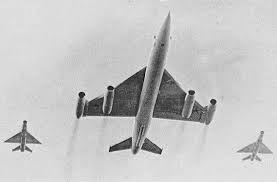
In 1955,the Myasischev OKB(bureau) has headed toward on a research to built a supersonic bomber. The archives of the design were the dash attacks,fast bombing, nuclear bomber.The project was begun in 1955 and 2 protypes were ordered from Soviet airforce.Many designs were made until they have a new designs
. The design name's M-50 for first prototype. 2 prototypes were built but only one of them, the M-50 were flown because the project was cancelled later. Even the project was cancelled, the M-50 still have a decision to made it final flight in Tushino show.  Another prototype for M-50 project, the M-52 also built as a nuclear bomber but after the project cancelled the aircraft complete but  it was never have flight test and scrapped . There are also many other projects about the M-52  with other configuration but they were never built.Later it was received  considerable attention from westerns observers and was given the NATO name's Bounder and presented at Tunisho show for now.
Description
Designer : OKB V.M.Myasishchev
NATO code name; Bounder
Role:Strategical supersonic bomber
Crew:2 pilots
Specification
1.M-50A
General characteristics
  • Crew: Two
  • Length: 57.48 m (188 ft 6 in)
  • Wingspan: 35.10 m (115 ft 2 in)
  • Height: 8.25 m (27 ft 1 in)
  • Wing area: 290.6 m² (3,128 ft²)
  • Empty weight: 85,000 kg (187,000 lb)
  • Loaded weight: 175,000 kg (386,000 lb)
  • Max takeoff weight: 200,000 kg (440,000 lb)
  • Powerplant: 2× Dobrynin VD-7M afterburning turbojets, 156.9 kN (35,270 lbf) each, and 2× VD-7B turbojets, 92.12 kN (20,710 lbf) each
Performance
Armament
  • 30,000 kg (66,000 lb) of bombs or missiles carried in internal bay
References:http://en.wikipedia.org/wiki/Myasishchev_M-50
2.M-52A
  • Length:57,48m  
  • Overall height:8,25m
  • Wing Span: 25,1m
  • Wing Area:290,63 m2
  • Take-off weight: 115000kg
  • Weight:78860 kg
  • Engines:2 VD-7B + 2 VD-7 turbojet engines
  • Speed:1050 km/h
  •  Practical range: 3150km
  • Practical ceiling: 11000m
  • Landing run:1800m 
references: http://www.testpilot.ru/russia/myasishchev/m/52/m52.htm


                                                                    Pictures


                                                                         M-50 drawings
                                             
                                                                     M-50 for today
                                                      M-52 wind tunnel models
                                                     
                                            M-52 prototype awaiting for test flight
                                            M-50 in flight